

Are We Teaching Answers or Awakening Curiosity?
Let me ask you a question.
When a child is born, what is the first thing they begin to do?
They observe.
They explore.
They touch.
They ask.
Why?
How?
What is this?
Children are naturally curious.
In fact, curiosity is the foundation of learning.
Yet, somewhere along the journey of education, many children stop asking questions.
They become more interested in getting the right answer than exploring possibilities.
Why does this happen?
Because in many classrooms, answers are rewarded more than questions.
But real learning begins not with answers.
It begins with curiosity.
The Problem with Giving All the Answers
Imagine a teacher enters the classroom and explains everything.
Every concept.
Every definition.
Every solution.
The lesson is completed.
The students write notes.
The class moves on.
But let us pause and reflect.
If students never ask questions, never investigate, and never discover, are they truly learning?
Or are they simply receiving information?
Information may fill the notebook.
Questions awaken the mind.
What Is Inquiry-Based Learning?
Inquiry-Based Learning is an approach where learning begins with questions rather than answers.
Instead of telling students everything, the teacher creates opportunities for students to:
- Observe
- Question
- Explore
- Investigate
- Analyze
- Discover
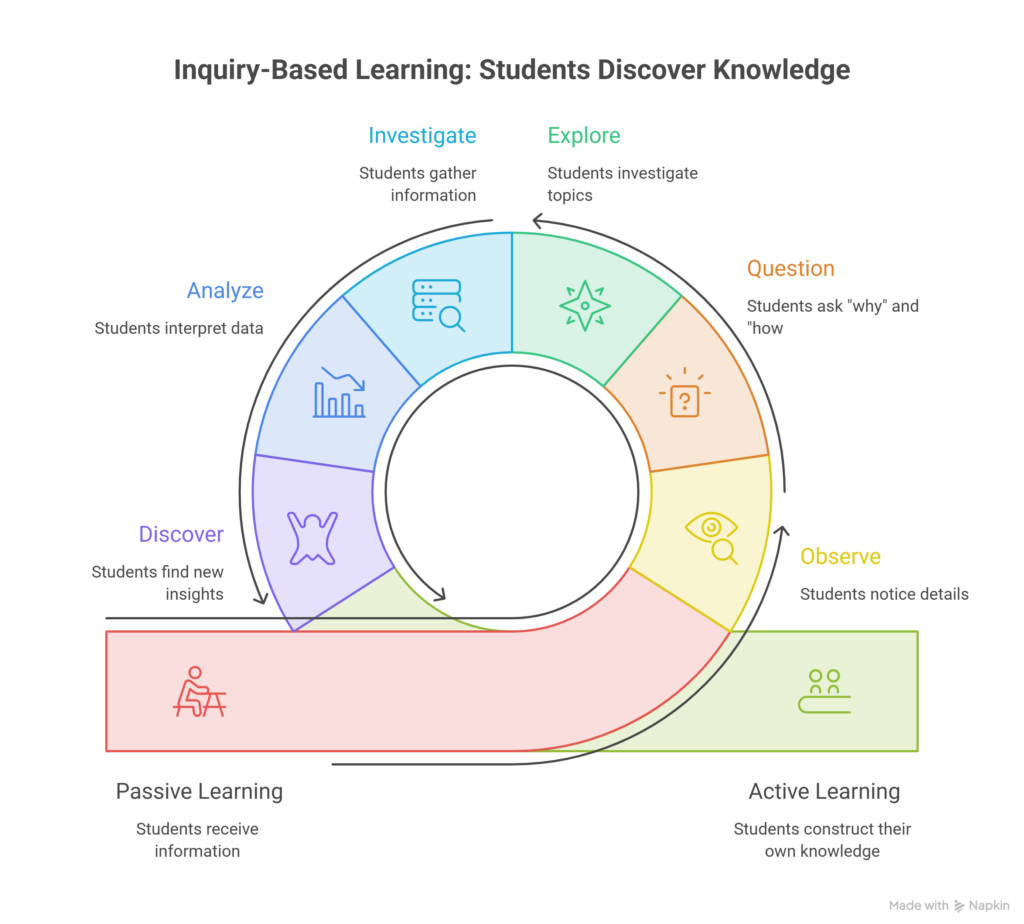
The teacher becomes a guide rather than the sole source of knowledge.
Students become active participants in the learning process.
Why Questions Matter
Every great discovery in human history began with a question.
Why do objects fall?
Why do plants grow?
Why does the sun rise?
Why do some people succeed while others struggle?
Questions have shaped science, technology, medicine, and civilization itself.
When students learn to ask questions, they develop the habit of thinking.
And thinking is one of the most valuable skills in the 21st century.
A Classroom Example
Suppose you are teaching the topic of evaporation.
A traditional approach might begin like this:
“Today we will learn about evaporation.”
The teacher explains the concept.
Students listen.
Now consider an inquiry approach.
The teacher places two bowls of water in different locations and asks:
“Why do you think the water in one bowl disappears faster than the other?”
Immediately, curiosity is activated.
Students begin thinking.
They make predictions.
They discuss possibilities.
Now learning becomes an investigation.
The concept is no longer something told.
It is something discovered.
The Inquiry Cycle
Inquiry-Based Learning often follows a simple process:
1. Ask Questions
Begin with curiosity.
2. Investigate
Explore information, observations, or evidence.
3. Analyze
Look for patterns and connections.
4. Discuss
Share ideas and perspectives.
5. Reflect
Draw conclusions and generate new questions.
Notice something beautiful.
Every answer creates another question.
Learning becomes a continuous journey.
Benefits of Inquiry-Based Learning
1. Develops Critical Thinking
Students learn how to analyze information rather than simply memorize it.
2. Increases Engagement
Curiosity naturally increases attention and participation.
3. Promotes Deeper Understanding
Students understand concepts more meaningfully because they discover them.
4. Encourages Independence
Students learn how to learn.
This is perhaps the most important skill for lifelong learning.
5. Builds Confidence
Students become comfortable exploring ideas and expressing their thoughts.
Common Mistakes Teachers Make
Asking Only Closed Questions
Questions with one correct answer often end conversations.
Inquiry thrives on open-ended questions.
Providing Answers Too Quickly
Teachers sometimes rush to solve the mystery.
Allow students time to think and explore.
Focusing Only on Correctness
Inquiry is about exploration.
Sometimes a wrong answer can lead to a powerful learning moment.
Ignoring Student Questions
When students ask questions, treat them as opportunities rather than interruptions.
The Teacher’s New Role
In Inquiry-Based Learning, the teacher is not simply an instructor.
The teacher becomes:
- A facilitator
- A mentor
- A guide
- A designer of experiences
The goal is not to provide every answer.
The goal is to cultivate curiosity.
A Reflection for Every Teacher
Think about your last lesson.
How many questions did students ask?
And how many questions did the teacher ask?
Now ask yourself:
Are my students learning to answer questions?
Or
Are they learning to ask meaningful questions?
The future belongs not only to those who know answers.
The future belongs to those who know how to ask better questions.
Final Thoughts
A classroom without questions is like a garden without water.
Learning may appear to happen, but growth becomes limited.
Inquiry-Based Learning reminds us that education is not about filling minds with information.
It is about igniting minds with curiosity.
When students begin asking questions, learning becomes personal.
When learning becomes personal, it becomes meaningful.
And when learning becomes meaningful, transformation begins.
So the next time you enter your classroom, try something different.
Do not begin with an answer.
Begin with a question.
You may be surprised by where it leads.
Reflection Question
What is one powerful question you can ask your students tomorrow that will make them think deeply?
Share your ideas in the comments and inspire fellow educators.