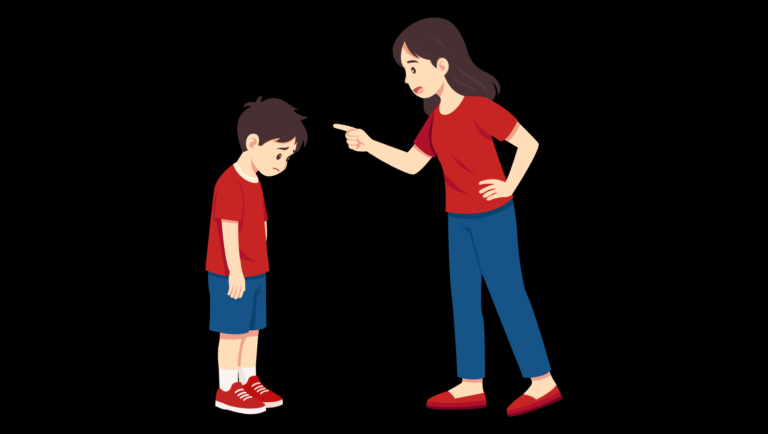

For centuries, education was largely about transferring information from one mind to another. The teacher spoke. The students listened. The teacher explained. The students memorized.
But today, information is no longer scarce.
A child carrying a smartphone has access to more information than the greatest libraries of the past.
If information is available everywhere, then what is the purpose of education?
The purpose of education is no longer to fill a child with information. The purpose is to awaken intelligence.
This is why active learning is not just another teaching strategy. It is a necessity for the 21st century.
1. Because Information Is Everywhere, Understanding Is Rare
Today, children can search for any fact within seconds.
But can they understand it?
Can they question it?
Can they apply it?
Active learning moves students beyond memorizing facts. It helps them analyze, evaluate, and apply knowledge, leading to deeper understanding rather than superficial learning.
2. Because the Future Needs Thinkers, Not Repeaters
Machines can store information.
Artificial Intelligence can generate answers.
But only a conscious human being can think critically.
Active learning develops critical thinking and problem-solving skills by engaging students in discussions, investigations, experiments, and real-life challenges.
The future belongs not to those who know the answers, but to those who know how to ask the right questions.
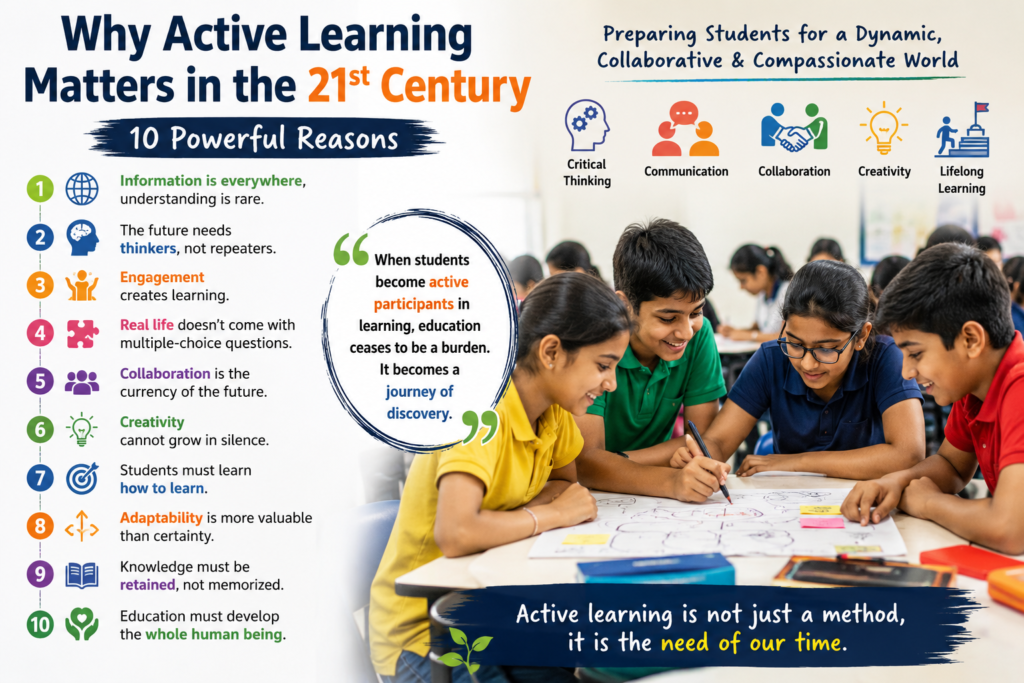
3. Because Engagement Creates Learning
Look at any classroom.
When students are passive, their bodies may be present, but their minds are somewhere else.
Learning happens only when attention is alive.
Active learning transforms students from passive listeners into active participants. It increases motivation, curiosity, and enthusiasm for learning.
A child who participates learns. A child who only listens often forgets.
4. Because Real Life Does Not Come with Multiple-Choice Questions
Life presents situations, not textbook questions.
A student may score 100 marks in an examination and still struggle to solve real-world problems.
Active learning encourages students to connect classroom learning with practical situations through projects, discussions, simulations, and problem-solving activities.
Education must prepare students for life, not just for examinations.
5. Because Collaboration Is the Currency of the Future
No major achievement in today’s world happens in isolation.
Scientists collaborate.
Businesses collaborate.
Nations collaborate.
Yet many classrooms still reward individual performance alone.
Active learning encourages teamwork, communication, empathy, and respect for different perspectives. Students learn not only from the teacher but also from one another.
6. Because Creativity Cannot Grow in Silence
Creativity is not something that can be taught through dictation.
It blossoms when students explore, experiment, question, and create.
Active learning provides opportunities for innovation, imagination, and creative thinking. Instead of reproducing information, students learn to generate ideas.
The world does not need more copies. It needs original thinkers.
7. Because Students Must Learn How to Learn
The greatest skill of the 21st century is not knowledge.
It is the ability to continuously learn.
Technology changes.
Jobs change.
Industries change.
Students who depend entirely on teachers will struggle in a rapidly changing world.
Active learning develops self-directed learners who take ownership of their learning journey, set goals, reflect on progress, and become lifelong learners.
8. Because Adaptability Is More Valuable Than Certainty
Many of today’s careers did not exist twenty years ago.
Many future careers do not exist yet.
How can we prepare children for an unknown future?
By helping them become adaptable.
Active learning places students in dynamic situations where they learn to respond to challenges, think flexibly, and develop resilience.
A flexible mind will always survive a changing world.
9. Because Knowledge Must Be Retained, Not Memorized
Many students memorize before an examination and forget immediately afterward.
This is not learning.
It is temporary storage.
Active learning improves retention because students engage with concepts through action, discussion, reflection, and application.
When learning becomes an experience, it stays with the learner much longer.
10. Because Education Must Develop the Whole Human Being
True education is not only about academic achievement.
It is about developing confidence, communication, emotional intelligence, leadership, responsibility, and awareness.
Active learning nurtures these qualities naturally. Students learn to express themselves, listen actively, respect others, and contribute meaningfully to a community.
The goal of education is not merely to create successful professionals.
The goal is to create capable human beings.
Final Reflection
The question is not whether active learning is important.
The real question is:
Can we prepare children for the future without it?
The world outside the classroom is dynamic, collaborative, creative, and constantly changing.
If classrooms remain passive while the world becomes active, we are preparing children for a world that no longer exists.
As educators, our responsibility is not to fill minds with information.
Our responsibility is to ignite minds with curiosity.
When students become active participants in learning, education ceases to be a burden.
It becomes a journey of discovery.
And that is what 21st-century education must be.