
What If Every Student Became a Teacher?
Let me ask you a question.
Who learns more in a classroom?
The student listening to the lesson?
Or the person teaching it?
Most of us would agree that the teacher often understands the topic more deeply because teaching requires thinking, organizing, explaining, and answering questions.
Now imagine a classroom where every student gets the opportunity to become a teacher.
Sounds interesting, doesn’t it?
This is the idea behind one of the most powerful active learning strategies: Jigsaw Learning.
The Problem with Traditional Teaching
In many classrooms, the teacher carries the entire responsibility of teaching.
The teacher explains.
The teacher asks questions.
The teacher solves doubts.
The teacher does most of the talking.
Meanwhile, students listen.
Some participate.
Many remain passive.
But what if learning could become a shared responsibility?
What if students could learn from one another?
This is where Jigsaw Learning creates a remarkable transformation.
What Is Jigsaw Learning?
Think about a jigsaw puzzle.
Every piece is important.
Without even one piece, the complete picture cannot be seen.
Jigsaw Learning works in the same way.
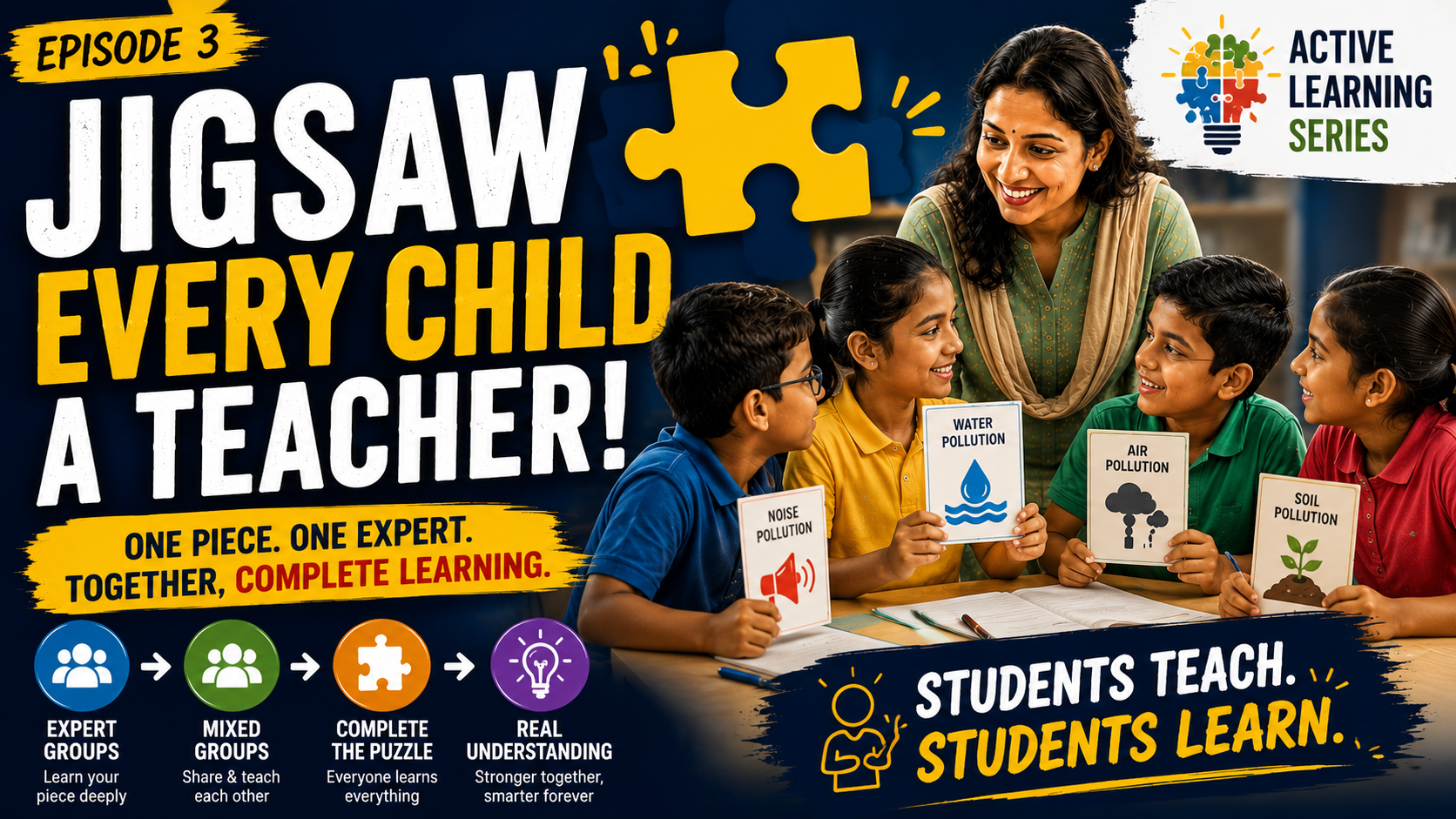
Each student becomes an expert on one part of a topic and then teaches that part to others.
Every student contributes.
Every student learns.
Every student teaches.
The classroom becomes a community of learners.
How Jigsaw Learning Works
Step 1: Divide the Topic
Break a lesson into smaller sections.
For example, if you are teaching the Solar System:
- Group A: Mercury and Venus
- Group B: Earth and Mars
- Group C: Jupiter and Saturn
- Group D: Uranus and Neptune
Step 2: Become Experts
Each group studies its assigned section.
Students discuss, explore, and understand the topic together.
Their goal is to become experts.
Step 3: Form New Groups
Create new groups with one expert from each original group.
Now every group contains different experts.
Step 4: Teach One Another
Each student teaches their section to the group.
Slowly, the complete picture emerges.
Just like assembling a puzzle.
Why Does Jigsaw Learning Work?
Because teaching is one of the most powerful ways to learn.
When students know they must teach others, they:
- Pay closer attention
- Understand concepts more deeply
- Organize information better
- Communicate more effectively
Learning becomes active rather than passive.
Instead of receiving information, students create understanding together.
A Classroom Example
Imagine you are teaching “Types of Pollution.”
Divide the class into four expert groups:
- Air Pollution
- Water Pollution
- Soil Pollution
- Noise Pollution
Each group researches and discusses its assigned topic.
Then students move into mixed groups and teach their area of expertise.
By the end of the activity:
- Every student learns all four types of pollution.
- Every student teaches one topic.
- Every student participates.
The classroom becomes alive with discussion and learning.
Benefits of Jigsaw Learning
1. Encourages Full Participation
Every student has an important role.
No one can remain completely passive.
2. Builds Confidence
Students gain confidence when they explain ideas to others.
3. Develops Communication Skills
Learners practice speaking, listening, and presenting information clearly.
4. Strengthens Collaboration
Students learn to depend on one another and work as a team.
5. Promotes Deeper Understanding
Teaching others requires genuine understanding, not simple memorization.
Common Mistakes to Avoid
Giving Difficult Topics Without Support
Students need guidance before becoming experts.
Skipping Preparation Time
Expert groups require sufficient time to discuss and understand their topic.
Making Groups Too Large
Smaller groups encourage better participation.
Rushing the Sharing Process
The learning happens during discussion. Allow enough time for meaningful conversations.
The Teacher’s New Role
In Jigsaw Learning, the teacher does not disappear.
The teacher becomes a facilitator.
A guide.
A designer of learning experiences.
Instead of carrying the entire responsibility for learning, the teacher creates conditions where students can learn from one another.
Final Reflection
A classroom should not be a place where knowledge travels in only one direction.
From teacher to student.
A classroom should be a living ecosystem where everyone contributes.
When students teach one another, something beautiful happens.
Learning becomes collaborative.
Learning becomes meaningful.
Learning becomes memorable.
And perhaps most importantly, students begin to realize that they are not just receivers of knowledge.
They are creators of knowledge too.
That is the true power of Jigsaw Learning.
Reflection Question
Think about a topic you will teach next week.
Could you divide it into smaller parts and allow students to become experts?
How might your classroom change if every child became a teacher?
Share your thoughts in the comments.