

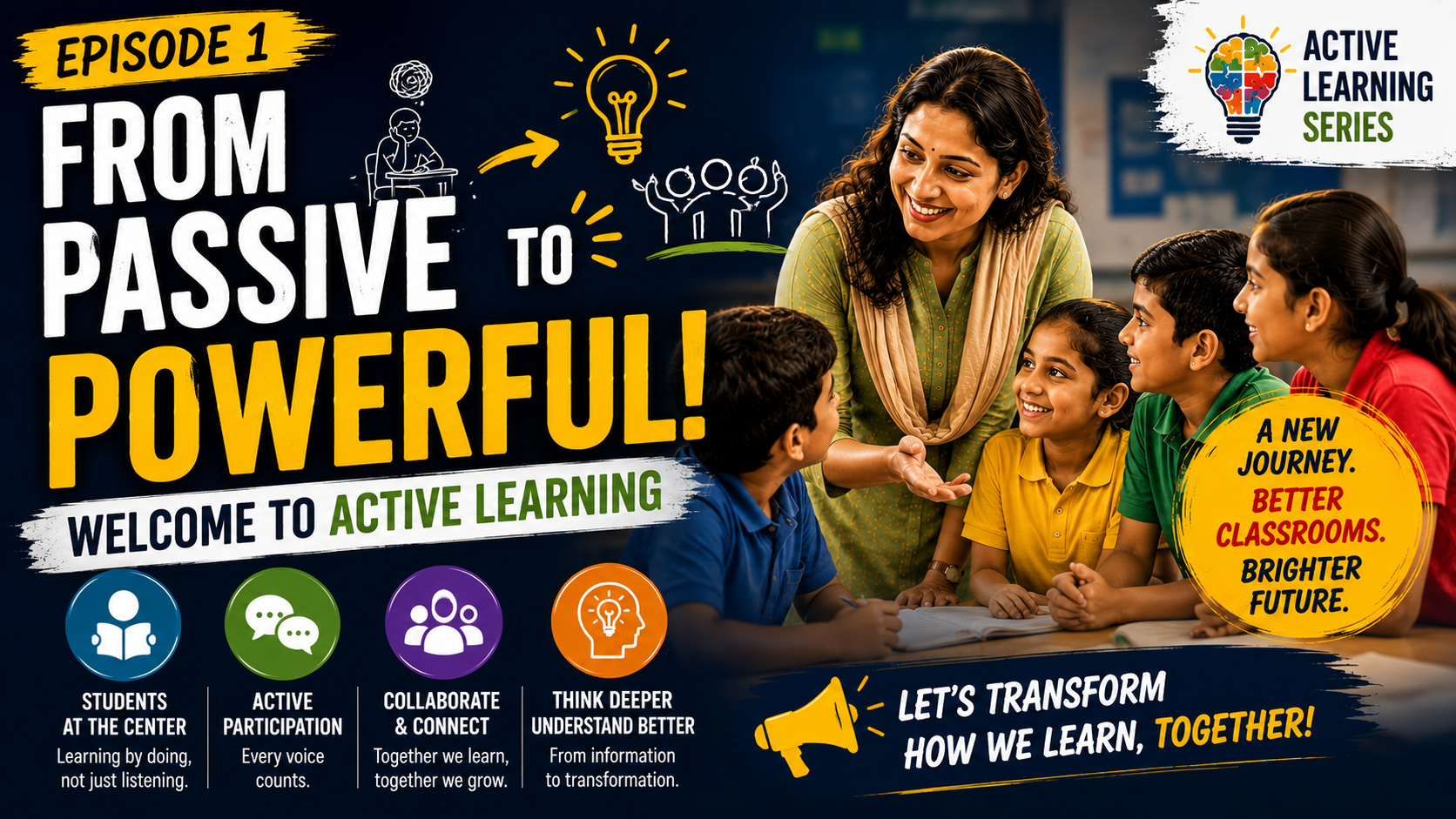
Are Students Really Learning?
Let me ask you a simple question.
Have you ever taught a lesson beautifully, explained every concept clearly, and then discovered that many students could not remember or apply what they had learned?
Most teachers have experienced this.
We often assume that if we teach well, students will learn well. But is that always true?
Perhaps the problem is not with the teacher.
Perhaps the problem is with the way learning is happening.
The Silent Classroom Myth
For many years, a silent classroom was considered a disciplined classroom.
The teacher spoke.
Students listened.
Notes were copied.
Homework was assigned.
The lesson was considered successful.
But let us pause and reflect.
Just because students are silent, does it mean they are learning?
Just because students can repeat information, does it mean they understand it?
Just because students score marks, does it mean they can apply their knowledge in real life?
These are important questions for every educator.
Information Is No Longer the Challenge
There was a time when schools were the primary source of information.
Today, information is available everywhere.
A student can access thousands of videos, articles, and explanations within seconds.
If information is available everywhere, then what is the role of education?
The role of education is not merely to provide information.
The role of education is to develop thinking, curiosity, creativity, and the ability to learn continuously.
What Is Passive Learning?
Passive learning happens when students receive information without actively engaging with it.
Examples include:
- Listening to long lectures
- Copying notes from the board
- Memorizing answers
- Repeating information without understanding
In passive learning, the teacher does most of the work.
The students become spectators rather than participants.
Learning becomes something that happens to them instead of something they actively create.
Why Passive Learning Falls Short
1. Students Forget Quickly
Research and classroom experience both suggest that information learned passively is often forgotten quickly.
Students may remember facts for an examination but struggle to recall them later.
Learning that is not experienced rarely lasts.
2. Limited Critical Thinking
When students only listen, they have fewer opportunities to:
- Question
- Analyze
- Compare
- Evaluate
As a result, thinking skills remain underdeveloped.
3. Low Engagement
Have you noticed students becoming distracted during lengthy explanations?
The human mind is naturally curious and active.
When learning becomes one-way communication, attention begins to fade.
4. Minimal Ownership
In passive classrooms, students often depend entirely on the teacher.
They wait for answers rather than searching for them.
They become consumers of information rather than creators of knowledge.
5. Poor Preparation for the Future
- Problem solvers
- Collaborators
- Innovators
- Lifelong learners
These qualities cannot be developed through memorization alone.
A Simple Reflection
Imagine two classrooms.
In the first classroom:
The teacher speaks for forty minutes.
Students listen.
In the second classroom:
Students discuss ideas.
Ask questions.
Solve problems.
Share opinions.
Create solutions.
Which classroom is preparing students for the future?
The answer is obvious.
The second classroom may appear noisier, but it is often richer in learning.
The Purpose of Active Learning
Active learning is not about making classrooms busy.
It is about making learning meaningful.
When students:
- Think
- Discuss
- Reflect
- Collaborate
- Create
they become deeply involved in the learning process.
And involvement is the foundation of learning.
The Teacher’s New Role
The future teacher is not merely a transmitter of information.
The future teacher is:
- A facilitator
- A guide
- A mentor
- A designer of learning experiences
Our role is not to fill minds with information.
Our role is to ignite minds with curiosity.
Final Thoughts
The challenge facing education today is not a lack of information.
It is a lack of meaningful engagement.
Passive learning may help students remember facts temporarily.
Active learning helps students develop the skills, attitudes, and understanding needed for life.
As educators, perhaps it is time to ask ourselves:
In my classroom, who is doing most of the work—the teacher or the students?
Because real learning begins when students become active participants in their own growth.
Reflection Question
Think about your most recent lesson.
How much time were students actively thinking, discussing, creating, or solving problems?
Share your thoughts in the comments and join the conversation.
It is absolutely correct but schools are not enough time for the students. Insted the school wants teachers to complete the syllabus.